

A new electrically powered filter can strip nearly all ammonia nitrogen from wastewater in just over a minute while also breaking down carbon-based pollution.
Researchers have developed an electro-filtration process that uses chlorine oxide radicals (·ClO) generated inside a specialized membrane to remove nitrogen and organic contaminants simultaneously. Reported in Engineering, the technology could provide a faster and more efficient way to treat complex wastewater without adding chemical precursors.
Wastewater treatment plants often rely on separate biological, chemical, and physical steps to control different pollutants. Ammonia can damage aquatic ecosystems by consuming oxygen and promoting excessive algal growth, while organic contaminants contribute to the chemical oxygen demand (COD) of discharged water.
A Membrane That Turns Ammonia Into Nitrogen Gas
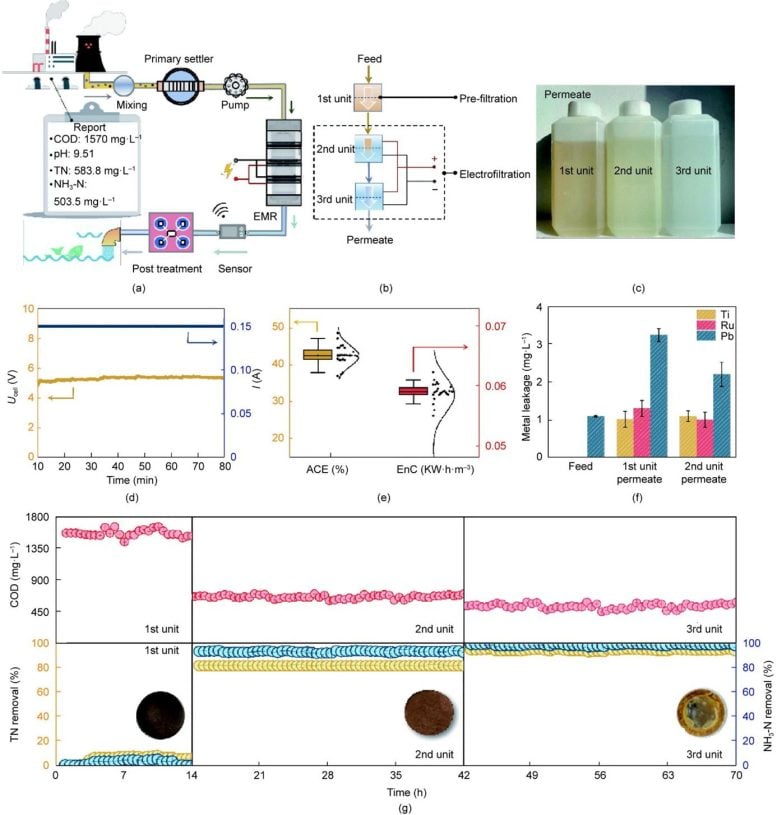
At the center of the technology is an electro-reactive membrane known as RuO₂@PbO₂-M. The researchers produced it using an electrodeposition-coupled template method that combines ruthenium dioxide (RuO₂) with lead dioxide (PbO₂), creating a porous surface that acts as both a filter and an electrocatalyst.
As wastewater moves through the membrane, reactions near the anode produce chlorine oxide radicals. These short-lived but highly reactive molecules rapidly attack ammonia nitrogen and help convert it into nitrogen gas, a harmless substance that already makes up most of Earth’s atmosphere.
The membrane removed nearly 100% of ammonia nitrogen with a retention time of only 1.2 minutes. During more than 70 hours of continuous operation, the system also reduced chemical oxygen demand by 68% and total nitrogen (TN) by 99.6%.
Why Ruthenium and Chloride Improve Performance
The strong performance resulted from the interaction between the membrane’s two metal oxides. Adding RuO₂ raised its oxygen evolution potential (OEP), suppressing an unwanted reaction that would otherwise divert electrical energy into producing oxygen. More of the available energy could therefore be directed toward oxidizing pollutants.
Chloride ions in the wastewater also supported treatment by promoting the formation of reactive chlorine species. Tests showed that current density, starting ammonia concentration, chloride concentration, and pH all influenced removal efficiency. The best results were recorded at a current density of 20 mA/cm², a chloride concentration of 100 mg/L, and an acidic pH.
Treating More Complex Industrial Wastewater
To test the membrane against pollutants containing both carbon and nitrogen, the researchers used acetaminophen (APAP) as a model contaminant. The system successfully removed both elements, suggesting that it could treat complex industrial effluents as well as ammonia-rich wastewater.
Combining decarbonization and denitrification in a single process could reduce the need for multiple treatment stages. Because the reactive species are generated in situ, the system also avoids the continual addition of chemical precursors. If the membrane proves durable and effective at larger scales, it could provide a fast, energy-efficient method for reducing harmful wastewater pollution.
Reference: “Simultaneous Denitrification and Decarbonization of Wastewater over In Situ Generation of ·ClO Radicals Through a Fast, High-Performance Electro-Filtration Process” by Bin Zhao, Jialin Yang, Ruiping Liu, Jiuhui Qu and Meng Sun, 16 July 2025, Engineering.
DOI: 10.1016/j.eng.2025.07.016
Never miss a breakthrough: Join the SciTechDaily newsletter.
Follow us on Google and Google News.